
Provisionality.
I feel like I’ve gone through my entire life with the annoying pop-up message in the corner of my brain: Your inventory is full! I have always been the kind of person to utilize my space. Desks, tables, dressers, nightstands and the like always have things on them. All over them, in fact. Medications, writing utensils, decorations I’ve been meaning to put up, a half-finished sewing project, my clay crafting tools, a birthday card from a month ago, a bill that still needs paid. Because if I put everything away, how will I find it when I need it?
But it’s hard to live with the mess, both physically and mentally. It’s draining trying to find room for something new, and having the guilt associated with clutter hanging over my shoulders. And sometimes I feel like I miss out on cool new experiences because of it.
Video games are similar. We have all been there: exploring in a sandbox survival game, or grinding materials in an MMO, and everything comes screeching to a grinding halt. Items litter the ground around you. Loot chests tempt you with all kinds of treasure. You’re stuck in a quest reward screen, faced with decisions you weren’t prepared for. Your inventory is full!
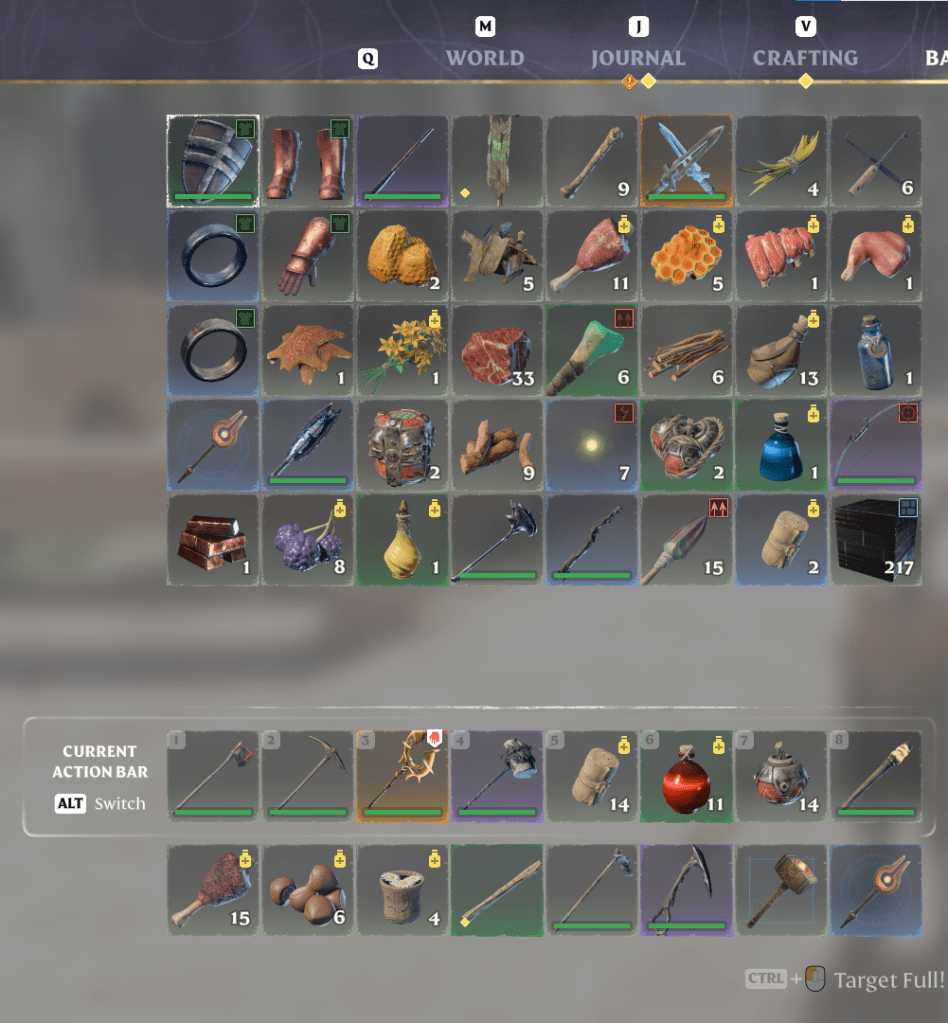
Thanks, past me, for having this example ready!
Inventory management is one of those pesky life skills that nobody teaches us how to do, but in both real life and video games, we are bogged down with the weight of a messy backpack until we put a system in place and can put things away. Each person’s brain is wired differently, so there are countless possibilities and mechanics for how storage works. It’s up to you to practice and experiment to find something that synergizes well with you.
There are three key features to learning to know what you have and where you have it: utility, category, and frequency. Building a system around these three features is what has helped me declutter my inventory so that when things are feeling heavy, I know where I can put things away so my adventures can continue.
Before we get into the grit of it, the kindest thing you can do for yourself is give yourself room for your system to change and grow as you do. You might outgrow your storage and need to expand. Eventually, you may no longer need some items that were critical in your day-to-day gameplay. Maybe items that used to be used in tandem are now needed in different recipes. It’s okay to change any of your inventory management systems if they’re no longer serving you. You don’t have to make grand and extravagant plans from scratch, especially if you don’t have the energy, or become intimidated by the scale of the project. You can start with small, practical changes aimed at improving your life, and make piecemeal progress. Learning to manage your inventory will be a lifelong journey. I hope that my advice can help make it more enjoyable.
Utility.
The state of being useful or beneficial, and by extension, the ways in which it can be used. I have a tendency to keep things often based on the possibilities they offer. As a crafty person and an artist at heart, I’ll hold onto all sorts of supplies, from fabrics and felt and thread to beads, wire, and keyrings, even soap molds and skin-safe scents. I like to go shopping for new hobbies at times, and even after I’ve faded out of the phase, the stuff sits around.
Marie Kondo said it best: The best way to choose what to keep and what to throw away is to take each item in one’s hand and ask: ‘Does this spark joy?’ When you look at some of the items you want to hold onto, what do you feel? Excitement about the possibilities of what you could do or make with something? Joy and nostalgia about the memories you’ve made with something? Shame over how infrequently something has been used? Sometimes, items don’t offer us the same utility that they have in the past. If it’s not currently serving you and just adding to the stress, it’s okay to let these items go. If you’re not ready to make a decision, you’re allowed to build in provisional storage spaces, too. Sometimes the act of putting something away to make a decision on it later can be that much more weight off your chest.
Category.
A division of items that have shared characteristics, and the groups of divisions that can harmonize with one another. Both in games and in life, it’s often unrealistic to compartmentalize individual items to their own separate container. Minecraft has 1,643 different kinds of items. It would be expensive spatially and resource-wise to have separate chests for every single item the game has to offer. And my bed only has so much room for boxes underneath it. To make up for it, I arrange my crafting supplies in categories, usually based around the activity. There’s a woodburning box. There’s a clay tool kit and small stackable crates to seal the different color clays away. I also have plastic totes filled with old drawing, schoolwork, and fanfiction for when I want to reminisce about what a dork I used to be and how much more of a dork I am now. A place for everything, and everything in its place.
Categories don’t have to fit any sort of traditional expectations, either. You can put things together in ways that make the most sense to you. Let’s take Minecraft, for example, because it’s a game I’ve been playing for a decade, and I’m very well-versed in inventory management with those blocks. Some people may opt to keep house building blocks together – logs, stone, brick. But some might prefer to keep their dark oak saplings, logs, planks, fences and the like in one chest so it’s easier to find. Even if they might use some of those parts as building blocks, neither means of storage is incorrect. Do you want to keep items together based on what they are, or what kind of processing they require, or what they will most likely become? The possibilities are endless, and ultimately, the decision is yours.
Frequency.
The rate at which something occurs or repeats, or more realistically, how often you’re going to have to access an item from its storage location. Some items are meant to be placed in deep storage, to be cherished and loved and remembered – or forgotten – and not used in your typical day-to-day. And some items may as well not even be in storage because you’ll need it on a daily basis, but it still helps for it to have a physical location tethering it down. Recently after getting home from a vacation, my life partner and I made a decision; we were tired of the daily ritual of finding the remotes so we can watch YouTube or Netflix or one of our favorite small streamers on Twitch. We bought adhesive velcro strips so that we could build a permanent place for the remotes to live. Gone are the days of overturning every couch cushion and checking every surface between the living and dining rooms. Even though the items aren’t meant to be put away in storage, they now have a dedicated space where they can (hopefully) always be found.
It’s also worth looking at the proximity in which items are kept near other tools that they would be used with. For example, in survival video games, perhaps you want to store your ores, or fuel for the furnaces, or other materials to be processed, and keep them right by their proper processors. Seeds can be kept right near your farm beds for maximum efficiency. Raw food ingredients can go near the cooking stations. Maybe in real life, you always keep your iron and your ironing board together. If these items are going to be used regularly, and used with these specific tools, it’s worth looking for a storage space that suits them.
Final Thoughts
I hope you can read through this blog and take something away from my ramblings. I’m well-aware that my systems may not work for everyone, and I take no offense to that. People are built different. We don’t have to understand it; we just have to respect it. While I was giving the actual symposium demonstration on inventory management and how to put it to good use, a lot of people connected with what I was saying, nodding along, even making self-deprecating comments about how inventory management wasn’t their strong suit. Let me clue you in on a little secret: it’s not my strong suit, either! The entire symposium on inventory management was cloaked in irony from the start! I wanted to give this talk and connect better with my disability in the process. Arguably, the most important thing I want to impart with you, the reader, is that inventory management is a skill, and like all skills, it requires practice to get any good at it.
Try to remember the three key features: utility, category, and frequency. Allow yourself to change and grow, both with your storage and yourself. And keep practicing! Eventually, you’ll know where everything belongs, and have a good instinct for where to put away new belongings.
SuperRedria64 was a participant in the Disabled Content Creator Collective’s first annual Disability Pride Raid Train, and spent their segment talking about inventory management and ADHD. Here’s where you can watch it!

 Cool Gamer Retirement Home
Leave a reply to thienlongswails Cancel reply