
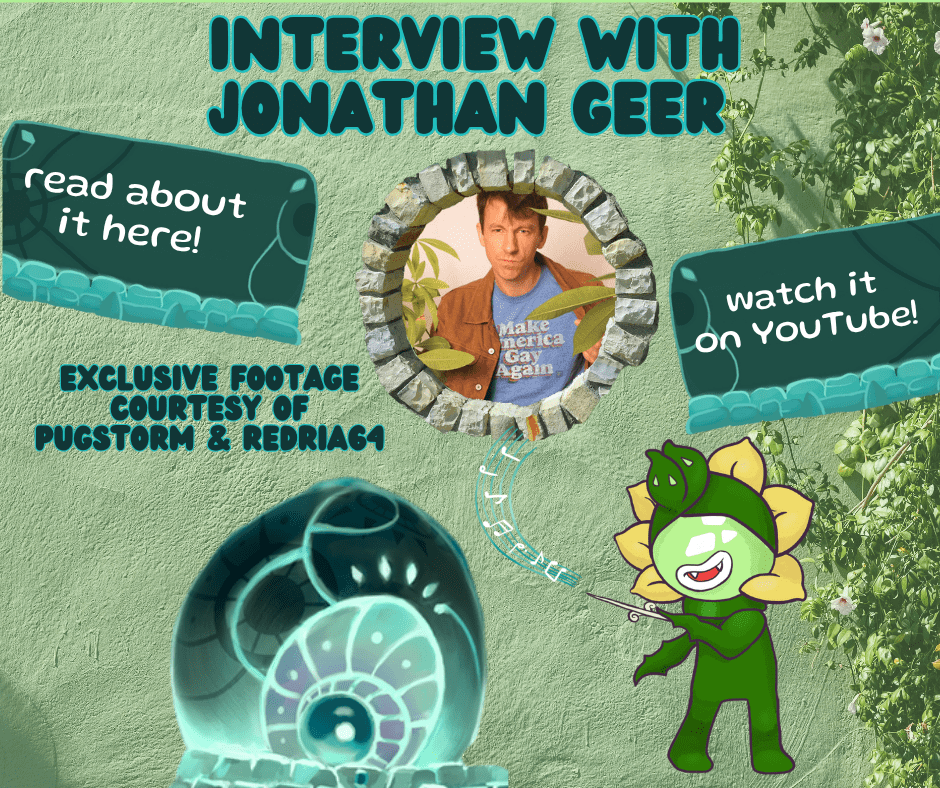
This PrideCraft, as we step away from Minecraft in the face of the Microsoft boycott, we pivot to look at other creative games we can cover… and we dream big. One of our founding members, Redria, has been accepted on as a Pugstorm Ambassador for their love of the Core Keeper music, and aimed to take it even a step further. That’s right – this Pride Month, we interview the composer of the Core Keeper OST, Jonathan Geer!
To kick off the interview and celebrate a spirit of creativity and collaboration, we premiered a cover of one of the Core Keeper tracks – Shimmering Frontier. Arranged by Ethan “DonutShoes” Desautels, it features himself on tenor saxophone, Kyra Lancaster on baritone saxophone, Miktastic on trumpet, and Redria on flute.
This blog post is meant to serve as a written transcript, so pull up the video and read along, if you’d like!
Tell us about yourself.
It’s cool, I love seeing my music and how it gets used in stuff.
I grew up in Texas and got into music when I was about ten years old, I would say. Started taking piano lessons. I guess I started kind of late with music in general, but once I got into it, that was it – I knew what I wanted to do. As soon as I started playing, I started making up my own stuff. And of course, I’d been into video games as a kid with the NES, and I think we even had an Atari at my grandmother’s house with some of those early Atari Olympic track-and-field kind of games. So I’ve always had video games in my life growing up. I ended up majoring in film scoring in college, and I’ve done a little bit of film here and there, and some music in quite a few different TV shows, but all that music comes through what are called music libraries, so it’s like a piece here and a piece there. I haven’t really scored, like, a whole television show with my music. But it’s cool, I love seeing my music and how it gets used in stuff. I ended up more in the video game world, which I love – because I feel like there’s so much good music in every conceivable genre happening in the video game world. And there’s so much opportunity to do really fun, creative stuff. I’m not mad that I ended up in the video game world.
What games do you like?
My playing time has decreased a bit, but I’m starting to get back into it.
Playing video games definitely stuck with me throughout my life. My husband and I ended up adopting kids – five and a half years ago we adopted our daughter, and our son two and a half years after that – I’m going somewhere with this. My playing time has decreased a bit, but I’m starting to get back into it. After we put the kids to bed, I’ll play for an hour or two. I’ve been playing this one, Expedition 33, which is great. I’m really loving that one – all the aesthetics, and actually the music is pretty great, too. And then The Alters, a few days ago – super fun, very unique video game. It’s like a sci-fi exploration game and you’re the last guy on a ship trying to make your way back home, and you have to make copies of yourself to get everything done. They really go all-in on the theme and how it works with the game mechanics.
Genre-wise, I love all the classics, the Nintendo franchises, all the Zelda and Mario games. Love a good platformer and kind of an adventure game. I just played through Astro Bot with my daughter not too long ago, and it was super fun – I feel like that’s the PlayStation’s new “Mario.” The boss fights were great and everything was just pure joy.
Redria: I’ve never had a PlayStation, but that is the one game that made me consider… because it looks so good.
Geer: It is *really* good, I highly recommend it. Great music, also. And honestly, I wouldn’t have played it, but Pugstorm, their Christmas bonus present to everybody was either a PlayStation, a Switch, or an Xbox, so I was like, well, I guess I’ll try it out then!
What instruments do you play?
Piano is the one I feel comfortable telling people I can play.
Redria: You mentioned you started your musical adventure on the piano. Did you pick up any other instruments?
Geer: Not really. I played French horn in band, I did the whole wind group through middle school and high school, but I didn’t really stick with it beyond high school-level. I like to sing and I’ve actually sung on some video game soundtracks that I’ve done, but even then I don’t always consider myself, like, a professional singer. So really, piano is the one I feel comfortable telling people I can play. I kind of dabble in some other stuff for when I’m recording, like when I play guitar, I literally have to record it a bar or two at a time. That’s the one other instrument I really wish I could play proficiently. It’s so portable and so flexible. I’ve kind of started a few times to learn a few chords.
I’m always impressed and a little jealous of people who are really good at, like, lots of different instruments… but that’s not me. I can load the sound up on my computer and play it.
Redria: My sister was the one who got the talent to be able to play, like, every single instrument… meanwhile, I *played* piano. I learned piano growing up, probably before I started playing flute, and as soon as I passed piano proficiency in college, I was like “alright, I’m done!” and sadly I haven’t had a piano to play in years. I do still play the flute, and I marched trombone in college, just because it was more fun to play something different.
Composition Software?
Generally, I’m just doing everything inside Logic and figuring it out as I go.
I’d say probably 98% of the time I’m just working in Logic Pro on Mac Studio, I pretty recently upgraded my computer. Working in Logic Pro with a lot of different plugins. Usually I’ll just create in there and not really use notation. Every once-in-a-while I get something that’s really contrapuntal. I mean, Logic has a notation section, but it’s pretty garbage, so you don’t really want to mess with it. So I have Dorico, I started with Finale, and way back when switched to Sibelius, and eventually switched to Dorico a few years ago. So I use that for my notation, but yeah, usually I don’t use notation, at least for most of the video game stuff, unless the song is basically finished and we wanted to add any kind of live overdubs. I did that for the Owlboy soundtrack. Everything was pretty much completely written in Logic already and I just notated out the parts for individual musicians for a flute player, a violin, and a cello – for that overdub stuff just to give it a nice, acoustic sparkle. Generally, I’m just doing everything inside Logic and figuring it out as I go.
What’s the process like?
At the very beginning we experimented with different ideas for the sound of the music.
When I very first started with them [Pugstorm], at the very end of 2021, or the very beginning of 2022 maybe, they had a good amount of art and ideas for tracks. At the very beginning we experimented with different ideas for the sound of the music. I have lots of early little experimentation files on my computer still – you know, stuff that wasn’t used in the game, stuff I was working on to figure out the sound. Once we had the sound figured out, probably for the first seven or eight tracks, they were fairly short – between a minute and a minute and a half each, and once I was really on board with the game and the team, we started sort of extending the tracks to closer to 3 minutes for each track, and having three to four tracks per biome. Once I had been on board for a few months, there was lots of art. I’m in a Discord for Pugstorm, the developer, and they’re posting all sorts of new art that they’re working on. I was able to go into Unity and test out the game. I started out doing just the music of the game, and then I think around October of 2022 they hired me on as an on-retainer employee to do both the music and the sound effects for the game. That’s when I started getting into Unity to implement the sound effects.
What inspires you?
A lot of times I’ll have inspiration from different kinds of classical composers… I’ve even like, quoted public domain classical tunes, like a little motif.
For this one – sometimes I will have a specific inspiration for a track, but for this one most of the inspiration comes from the game itself. There were a few – I know one track. I didn’t have it as a conscious idea when I started the track, but then I was playing around with it and I had this melody in there that was very reminiscent of Final Fantasy. I honestly thought when I handed it back over to the team, they were gonna be like, “no, you can’t do that. That’s just straight up ripping it off.” But it sounded really good in the track, and they liked it. The team had been growing, and there were enough people that I feel like my sample size of people is pretty good. Literally nobody commented at all, so I thought, well, maybe it’s okay then. I think it was on Light Traveling. Like 30 – 40 seconds into the track, there’s something that, to me, is like totally Final Fantasy. Sometimes, some of that kind of stuff sneaks in there.
A lot of times I’ll have inspiration from different kinds of classical composers. Not in Core Keeper, but in some other games, I’ve even like, quoted public domain classical tunes, like a little motif or something. From Core Keeper, I’d say I was mostly inspired from the game. I did have one other track that I was kind of inspired by the early Castlevania game tracks, in Living Walls.
What about the boss fight music?
I’d say, process-wise, it wasn’t really any different, but the vibe was completely different. Once we found the sound for the game, it was kind of very cozy and pleasant and soothing for the most part. All the biome music. Even if what was happening in the game isn’t necessarily so pleasant. But all the biome music itself is pretty relaxing. Totally different when you get to the boss fights. Process-wise it was very similar, just going in a totally different direction.
Redria: Did they have you fight any of the bosses?
Geer: Yeah – well, I’ve played – eh, I wouldn’t say a decent amount of the game. Once I started doing the sound effects and music, too, I was able to go into Unity and I’d have all of the developer cheat codes. I could be like, “/player SuperStrong, /player Invincible” so I could try out everything. Otherwise, it probably would have taken me a lot longer! But I was able to teleport around and try things out, so I was able to test them all out. A lot of it was more for the sound effects, and the timing of that, and seeing how it interacts with everything.
Redria: It’s nice to know that you did a lot of the sound work for this game as well, I don’t know if I knew that going into this interview today.
Geer: I haven’t really done a ton of sound design work for the other games I’ve worked on. It just kind of happened that I was doing the music, and the team was like, “Hey, would you maybe wanna make our sounds a little better, too?” And I said sure! I did most of the sounds in Owlboy, too. Most of the other stuff it’s been just the music. That’s a totally different process, though, and one I’m still kind of learning about. It’s been super fun to have that opportunity to work on that skillset as well.
Favorite biome?
It is hard to choose, though.
Redria: Is it the crystal biome?
Geer: I think it is. It’s very hard, I don’t know – I’m honestly careful with favorites in general, like “give your top ten movies” or this or that, like, it’s so hard to choose! But yeah, if I had to choose, I would probably go with the shimmering frontier. I’m kind of a sucker for – yeah, it’s so beautiful! It’s very fun, and everything – I love the whole vibe and the music for it, and really fun sound effects, too. Yeah, that would be my favorite. It is hard to choose, though.
Redria: It is very hard to choose. I think some of my *least* favorite – I am so bad in the desert. It’s such a pretty vibe, but I am very bad at surviving in the desert. Therefore, that has made it my least favorite.
A musical motif?
Redria: I noticed a callback motif between Return and Echo of the Past and I didn’t know if that [musical motif] was a regular thing that you tried to utilize.
Geer: Yeah, I’ll try to use that here and there, especially since that was like the main credits song. I think more of that one was even – I think now it’s just a track that plays in the dirt biome, but it originally was gonna be – I think it’s called Ancient Blue. It was originally gonna be more of a base theme. I used that one probably the most, the motif in that one. A lot of times I’ll write a piece and I don’t have a name when I’m writing it. And the team helps me out with names sometimes. I think Ancient Blue is the one I used the motif from. And that’s quoted in Return, too.
I like to do that as much as I can, as much as it’s appropriate, to kind of tie things together with the game and the soundtrack. I didn’t have, like, a ton of that in Core Keeper. It seemed like a good time to bring back one of the main themes in the end there.
Redria: I haven’t played Owlboy or listened to the full OST yet, but do you feel like there are other instances where you use motif more?
Geer: I would say Owlboy, definitely uses it quite a bit more. Owlboy is a more narrative-driven game.
Finding the “sound”
Redria: It sounded like there’s a process to finding the actual sound for the game by making a lot of smaller tracks and then kind of lengthening them out once the team agrees on what the sound is.
Geer: That’s totally it. I’d say that probably it’s a different experience for each developer or team. Generally, that’s kind of the way it’s gone for most of the developers I’ve worked with.
Other composers you like?
That’s what I had on my list so far but, my gosh, there’s so much good music out there.
Redria: A lot of the stuff we listen to for co-working and art streams, among the Core Keeper soundtrack, we also have Dale North with Snacko, David Fenn with Moonlighter. I didn’t know if there were other games or composers that inspired you.
Geer: I was just starting to make a list. David Fenn is a good one. I just played Death’s Door not too long ago, it was a great soundtrack. I actually have not played this game too much, I played a little, but the music just sounded really cool – Eastward. I looked up the composer because I didn’t know his name, Joel Corelitz. I like a lot of the classics like Koji Kondo, Nobuo Uematsu – I love Final Fantasy and everything. I really grew up on those Final Fantasy, like the early games. I think Final Fantasy II was the one where I was like, oh my God. I love this so much. Shadow of the Colossus, I love that score. The composer’s name, Kow Otani, that one was great. I think they, like, only had music during the boss fights in Shadow of the Colossus, and apart from that, you’re kind of wandering the world. I remember the way they even did the music in the boss fights, the way the music adapted to the intensity of the fight, it was really well done. It was a big symphonic sound, I think they recorded it with a live orchestra, but the way they pieced it together during the boss fight, like transitioning to different tracks based on the intensity of the fight was really well done. I had Gareth Coker on here, with the Ori games –
Redria: Yep! I listened to the Ori soundtracks before playing it, and it was even more magical then, getting to the area in the game and listening to the music in that context. Sorry to interrupt.
Geer: A game I just started, which has really great music so far, one I watched the trailer for before I played it, it’s called Planet of Lana. The composer’s Takeshi Furukawa. So far, really great music. Disasterpeace I have up here, Hyper Light Drifter is really cool – I’ve only played the first one, I haven’t played the – and I don’t even know if he scored the next one. But yeah, the original Hyper Light Drifter, very cool. That’s what I had on my list so far but, my gosh, there’s so much good music out there.
When are composers brought on board?
There’s a lot of this experimentation at the beginning part, which is kind of fun!
I feel like probably people are bringing composers and audio guys on pretty early in the process. I know Core Keeper, it was pretty early, but they had a playable game. I’m trying to even think if they were – I don’t think they were in Early Access when I started, I’d have to look it up, but I think they had a solid amount of the game that was playable, a lot of the systems in place when I started on music for that.
I’m thinking Owlboy, that was a little different. I was actually working on a different thing with a couple of the Owlboy guys, though Owlboy always stayed a really small team, like at max we had five people, at most, ever, on that game. It was pretty much: artist, programmer, composer, and we had a guy who lived in Canada who helped out with marketing and PR stuff. Super tiny team. That one, I was in at ground zero. There was, like, nothing, and we were kind of working on it all at the same time. I was experimenting with main theme ideas and they were just doing the beginning artwork.
Most of the time, there’s a good amount of concept art for the game, and maybe something playable when they’re bringing a composer on. Like I said before with finding the sound of the game…
Another developer, 10Tons in Finland that I’ve done a handful of games with – they’ll kind of give you a description, track lengths, and a lot of times, a reference track – in other words, like, “here’s a track so-and-so wrote for this game”, or even for a show or a movie, it doesn’t necessarily have to be a game. And this is kind of the general vibe we’re going for. And I’ll just kind of base my music, or use that reference track as kind of an inspiration.
Core Keeper, I don’t even think we did any reference tracks. The Core Keeper team came to me because they liked the Owlboy soundtrack. Basically, they were like, “we really loved Owlboy. Can you do something along those lines, but developing its own kind of identity and sound for Core Keeper?” So I guess my reference for Core Keeper was Owlboy… I guess.
There’s a lot of this experimentation at the beginning part, which is kind of fun! You can just kind of play around with different ideas – it’s a fun part of the process.
Career history?
I’m not composing, I’m not doing what I want to do. So that year I was determined to find some kind of work as a composer.
I majored in film scoring, went to school in Boston – graduated at 20 or 21, moved back to Texas where I grew up. For like, four or five years I was just kind of teaching piano lessons and I had a church gig on Sunday, played some weddings here and there and played a few gigs out and about. But I think by the time it was 2005 or 2006, after I had been kind of doing this for a few years, I realized, I’m not composing, I’m not doing what I want to do. I’m not composing for films, I’m not composing for video games. So that year I was determined to find some kind of work as a composer. So I got involved in the development forums, sent lots of emails, made a little portfolio of my music… eventually I got hooked up with the Owlboy team and a few other developers. But one day I had to say, I’m gonna do this, let’s figure this out. Owlboy was a huge help. It took a while for us to finish the game, almost a decade, but that did open up some other doors – it opened the door to Pugstorm and Core Keeper and that was a really great game to work on, and the people that I worked with were amazing. We met up in Norway after we finally finished the game. And yeah, it definitely opened up some doors to continue doing this video game music.
Redria: I definitely understand about sometimes having to just do it – I was nervous about sending you an e-mail, I’ll be very honest. I love music and I was like, “Eh, he probably doesn’t wanna talk to me.”
Geer: In general, I don’t really do that many interviews and, kind of thankfully, not too many people have asked me. It’s not really something – I’m not a talker or like, sit down and talk for like hours and hours, but like I said, there haven’t been tons of requests, so I said it was time for an interview. So I was nervous, too.
Collaborating with live musicians
It just brightens it, makes it pop a little more, gives it a little more life.
Most of the time I’m just in my little hermit composer cave just kind of doing my thing, but I’d say in regards to live musicians, honestly I wish I could do more stuff with live musicians. I love doing that and I’m always trying to get developers to sign off on that. With Owlboy I would say it didn’t dramatically change any process or anything but I think it did make a significant improvement in the sound and the emotion, just having those live instruments. I should do an A/B video, like you listen side by side to the midi version, which you know – I really work to make it sound as good as I could, but even when you A/B a really nice MIDI mock-up with the live instruments, either in-place or overtop the MIDI, it’s a pretty noticeable difference, even to non-musicians. So I am always trying to bring live musicians into the process as much as I can, as much as the developers are into it.
With Owlboy, a lot of the times in the MIDI produced track, it was fully-produced but there was a big orchestral string sound and I would bring in a violin, viola, cello, bass, and just kind of blend it into the bigger sound and it just brightens it, makes it pop a little more, gives it a little more life. And sometimes there would be like a solo instrument, in the main title music of Owlboy there’s an oboe and it’s a slower version of the main theme, and there’s like a solo oboe right at the very beginning. And so in those instances I would just completely replace the MIDI in there, and it would be replaced with the live oboe. And that makes a huge difference. There was another track like that and it had a solo bassoon. We replaced a MIDI bassoon with a live human player and it was like, night and day.
Live instruments in Core Keeper?
Yeah, I’m always trying to do more with live instruments.
In Core Keeper, there was no live stuff at all in Core Keeper. I try to make my MIDI sound as good and lush and organic, you know assuming that’s the sound you want, you want to make it sound as good as you can. I did do a few arrangements of the Core Keeper tracks that I recorded with a small live group, but as far as the actual OST there’s nothing live.
The one I did not too long ago where there was lots of live stuff and it did make a pretty significant difference in the music – it’s a game in this cooking series called Cook, Serve, Delicious!? It’s the fourth game, Cook, Serve, Forever. And those are the ones – the third game and the fourth game – those were the ones I did a lot of singing on, and I also – both of those has a lot of live piano recording. And Cook, Serve, Forever, I invited a lot of people to do solos and kind of put their own thing in there. A lot of pop / jazz, it’s got a little bit of Latin jazz in there too with some weird Spanish pig Latin in the vocals, but that allowed it to have a pretty big impact because I left some space for some improvisation solos and there was enough of a live overdub to make up a pretty significant chunk of the sound, which was great. I got to reconnect with a friend from High School who lives in Chicago. He played a lot of beautiful Flugelhorn and trumpet parts on it. Yeah, I’m always trying to do more with live instruments. I know I brought it up to the Core Keeper developer at one point and we never ended up adding it, but yeah, it’s always something I’m trying to do.
Currently listening to?
I’ve been listening to – I’m going to pull up her name – Ichiko Aoba, she has an album that just came out called Luminescent Creatures not too long ago. I’ve been listening to that a lot. A little bit as inspiration for something I’ve been working on with the Pugstorm team. It’s very gorgeous. This one, very ethereal and meditative, has a lot of really beautiful melodies and interesting harmonies, but yeah, definitely recommend Luminescent Creatures. What else… that’s the main one I’ve been listening to. I don’t know if you’ve heard of the singer Arooj Aftab? She’s really amazing, very minimalist, a little bit of jazz influence, but her voice, she has the most incredible voice. Arooj Aftab. She’s really good. My friend invited me to go see her, she’s doing a show in Denver Colorado in September and it is tempting. She’s a Pakistani-American singer.
Do you turn down work?
Usually when people come to me it’s because they heard something else I did, so they’re wanting something already in my skillset.
I’ll sometimes pass on things. My inbox isn’t like, you know, flooded with things that I’m having to turn down tons of work. But I’d say I don’t say yes to everything that comes my way. If it looks interesting and kind of aligns with my skillset and I’m getting good vibes from the developer and the project, and budget looks okay or we can work out something, I’m definitely inclined to say yes. Unless there are red flags or unless it’s just not a good fit for me at all. But usually when people come to me it’s because they heard something else I did, so they’re wanting something already in my skillset. Most of the work that comes my way I’ve said yes to, but I’ve turned down a few things here and there, either for budget reasons or otherwise.
Current projects?
…they have another game they’re working on called Kyora, announced at The Game Awards.
I’ve been part-time with Pugstorm working on Core Keeper and they have another game they’re working on called Kyora, announced at The Game Awards. I’ve worked on that as well, made a fair amount of music for that, and sound effects, too. I finished the Cook, Serve, Forever soundtrack not too long ago. I’ll be working on some more stuff with that developer – David Galindo, Vertigo Gaming Inc. I will do some stuff for music libraries here and there throughout the year. And that’s the stuff that ends up all over the place, like the music that ends up on a TV show, that’s from the music library. Usually with those, it can vary but it’ll be a CD of ten to twelve tracks of a certain style. It can range from Latin jazz to orchestral adventure music or light underscore pizzicato – anything you hear in the background of a reality show or a competition show. I’m finishing up some work with a guy in Mexico City, Alonso Martin, a game called Heart Forth Alicia, which – I think he’s gonna win the award for longest development time, he’s already surpassed the Owlboy team, I think it’s been over a decade now but he’s still plugging away at it. This last bundle of music tracks I made are almost done, I’m working on like one short little minigame music piece that I’m about to finish up. I think this is one of the last bundles of tracks I’m doing for it. That’s what he tells me – he tells me we’re very close.
In whatever other spare time I have I like to write some chamber music here and there. I had a piano trio – piano, violin and cello that I played with quite a bit back in the day and I wrote a lot of music which was super fun. I don’t play with them as much anymore but I play with them in a tango band that also adds bass and bandoneon, and so I’ve arranged some of our trio stuff for them and I’ve written a good amount of original stuff for them. That’s always super fun. When you’ve been playing with a group of people for a while and can write music for them, have it performed, it’s just really exciting to have, to have the live music and to really know the people you’re writing for, too. It’s nice to be able to bounce back and forth between different stuff like that.
Any live ensembles?
It’s very satisfying, it makes you feel good, making music with other people like that.
Redria: I wish I had more time to be able to play, but that’s the one thing – between full-time work, part-time streaming, I don’t think I have time, actually, for any ensembles in my life. Hopefully some day soon.
Geer: We just moved to Mexico not too long ago, but I want to find some kind of group here to either – anything, really, it could be a choir to sing with or a chamber group to play with and partly just so I’ll have a group and a connection, and then have people to practice my Spanish with, too.
Redria: My sister actually just played a jazz band called the Final Boss Jazz Band and it was all video game music. And I was like, this is everything to me. Can I join your group? I know I can’t, because I don’t have time for recitals – er, practices, but I wanna be in it!
Geer: Yeah, you’ll have to find some time. It’s very satisfying, it makes you feel good, making music with other people like that. Good for the soul.
How can we support you?
The most helpful way is buying albums on Bandcamp, for sure.
The best thing is to buy albums on Bandcamp. jonathangeer.bandcamp.com it’s got all my stuff on there. Almost all my stuff is on streaming, most of my stuff is through Spotify. Streaming, people can play it and it’s not great, you get paid 0.000- whatever per stream, but anything helps. The most helpful way is buying albums on Bandcamp, for sure. The album I just put out, it’s called Terror Squad, it’s for a game that never ended up getting developed. The same guy I worked on all the stuff for Cook, Serve, Delicious!? with. He did this one game called ChefSquad, I still don’t totally understand how it worked, it was a game you played on Twitch in a stream with other people, and it was a multiplayer game, and it was kind of a cooking game sim. I never actually played it, though, but I wrote a bunch of silly songs for it. And this was going to be a similar thing as a Twitch game, but it was going to be a horror Twitch game. But it was never developed, and he said it was never going to be developed, so he said if you want to throw the album out there, go for it.
Hey there, little kitty bitty!
But yeah, Bandcamp, or streaming, I’ll take the streams.
Advanced music courses?
I don’t think I took any AP music theory, not like in high school, but I did – I had a piano teacher in Dallas who we had separate group theory classes, they got fairly advanced. And I would take the TMA? Like, they have theory tests for each level, all the way up through high school, and by the time you get to the end of high school-level theory tests it was pretty intense, you were set up for some high level theory stuff. So I did theory all through high school – separate classes for that, so I was pretty set on my theory.
I’m sure I probably would have taken a music AP test but I don’t know if that was an option when and where I was. I remember I took some of the AP tests like for math and science, but I don’t think I got any 5’s. I think I got a 2 on one of them. I got good grades but they were very hard. Once I got into college I did some placement exams for classes. One of the theory classes, I told them I think I know all the stuff you’re going to go over.
Experimenting with style?
I don’t think I’ve ever worked with something that I regret – I love trying new styles, new genres and new sounds.
I don’t think I’ve ever worked with something that I regret – I love, even if I’m not always the best at a genre or a style, I love trying new styles, new genres and new sounds. Like this one I did was kind of like a – it’s on Bandcamp actually, it’s called Neon Chrome, it’s kind of a retro cybernetic kind of game with a pretty different kind of soundtrack to work on, and it turned out very well, I’m really happy with that. I did this one, a video game soundtrack that was very right up my alley, called King Oddball, I think it was a mobile game, but they wanted a soundtrack that was – sounded like Astor Piazzola, he’s a nuevo tango composer, and he’s actually the composer my tango band plays, like we play all the music of Astor Piazzola, and then we started doing some original stuff too. When the developer asked me to do the Astor Piazzola style soundtrack, they didn’t know that I played in a band that played all his music. It was a very kind of random niche thing and I said it was literally right up my alley, I can do it. Most of the stuff I’ve done has been kind of this mix of orchestral and blending that with more electronic sounds or retro sounds. I haven’t really gone too – I’ve done a lot, with the cooking games, going to the jazz side of things, and even pop on the Cook, Serve, Forever, the vocal tunes and that was fun, certainly not something I expected to be doing. I’m trying to think of a style that I haven’t done that would be fun to do. I don’t know, I’ll have to think about that. Honestly I love a challenge and I love exploring different genres and kind of outside of the music part a little bit, but once I started working on the sound effects for Core Keeper, I started getting into – I’m not sure if you’re familiar at all with Eurorack modular type of stuff but I started really getting into that for sound design and that’s been a whole other rabbit hole, take over your life type of rabbit hole to go down. And take over your wallet, too. But it’s been really fun and definitely outside of my comfort zone. But talking about experimental stuff, it’s kind of infinite possibilities in that realm.
The first step?
I usually have some crumb of inspiration, either from a book, or music, or some artwork.
The video game scores, it’s usually an experimental stage, I’ll usually have a good amount of concept art or reference track, so I have a good point of entry for stuff like that. With other things, like chamber music writing or writing for my tango band or piano trio… I’ve got a little upright Boston piano in my studio and I like to doodle around with ideas on that and come up with motifs and different ideas. A lot of times for the chamber music stuff I pull a lot of inspiration from books, sometimes from artwork, sometimes – I’ve written pieces, for the tango band I wrote one that was very inspired by an Edith Piaf song and sometimes I’ll take direct inspiration from a particular song. And then I also, with a Debussy piece, Passepied, that little ostinato, I don’t know if you know that piece – there’s a little left hand eighth note minor ostinato thing that kind of runs through most of the piece, I kind of used that idea as the basis to start one of my tango band pieces. I usually have some crumb of inspiration, either from a book, or music, or some artwork.
When I was younger and first started out composing, I loved to do imaginary soundtracks for books. I did a ton of them. I read a lot of Ray Bradbury short stories and I’d have the story in my head and I’d actually write the soundtrack to the story playing in my head. I wrote soundtracks for Crime and Punishment – Dostoevsky, for Les Miserables, and Robert Jordan’s The Wheel of Time series. I wrote soundtracks for those books. I really have all sorts of places for inspiration for getting a track started.

Hopefully you enjoyed this interview with a video game composer as much as Redria did – because there may be more of these in the future.
 Cool Gamer Retirement Home
Leave a comment